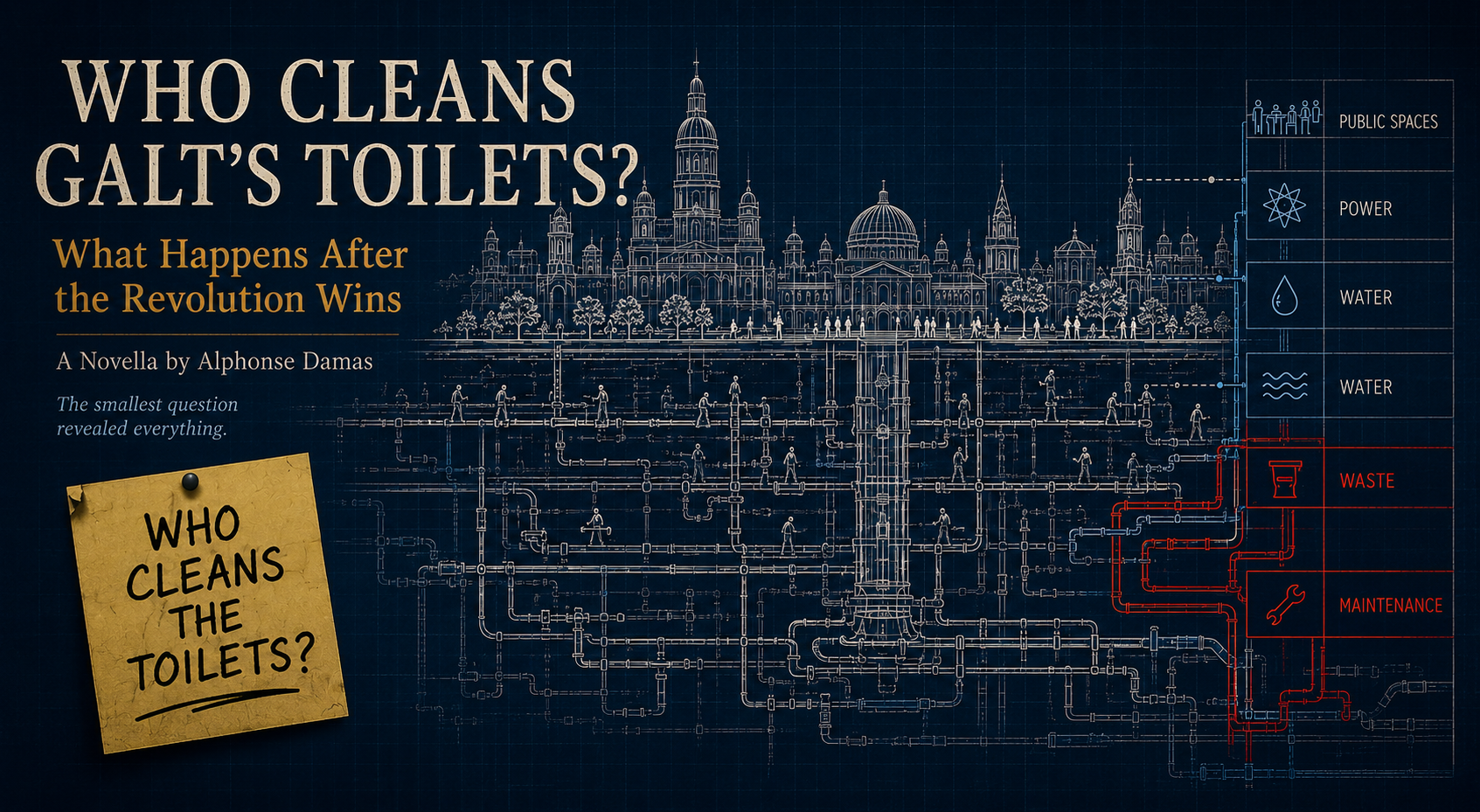
Who Cleans Galt's Toilets?
What Happens After the Revolution Wins
The revolution succeeded.
The architects escaped.
But paradise still needed someone to clean up after it.
The Question
Who serves the dream after the dreamers declare themselves free?

What Happens After the Revolution Wins
The revolution succeeded.
The architects escaped.
But paradise still needed someone to clean up after it.
The Question
Who serves the dream after the dreamers declare themselves free?
World Synopsis
The Founders’ revolution succeeded. They withdrew from the old world, built a new civilization around excellence, contribution, and freedom from unearned obligation, and became revered ancestors.
Generations later, Elias Vale, a sanitation and infrastructure maintenance worker, loves the city from below. While repairing Founder Hall’s waste systems, he notices that the families who speak above the marble halls are not the families who maintain the pipes behind them.
Elias begins examining public records: academy admissions, leadership positions, research institutions, council appointments, marriage patterns, and maintenance assignments. The same elite surnames appear repeatedly in positions of prestige, while the same continuity surnames cluster in maintenance and support roles.
The pattern is not simple corruption. Many Founder descendants are genuinely capable. But capability is cultivated through inherited proximity, marriage markets, mentorship, assumptions, education, and social permission.
Atlas Reflection
To explore what happens after a meritocratic revolution succeeds and becomes a civilization with descendants, institutions, marriage markets, inherited proximity, and maintenance classes. This world exists to ask whether any system can permanently prevent its own success from becoming a new hierarchy.
Opening Pages
The prologue is the public threshold into this world. Begin here.
Prologue
After Victory
Beginnings, Endings, and the Shape of Decline
History has a weakness for beginnings. It celebrates revolutions, remembers declarations, and immortalizes founders. The moment a civilization is born, historians rush to record its first breath; far less attention is paid to its last. Perhaps that is because endings are rarely dramatic. Civilizations do not usually die in a single moment. They drift, adapt, and become something else, until one day their descendants no longer recognize the world their ancestors built.
A Civilization That Succeeded
This is not a story about a civilization that failed. It is a story about one that succeeded. Its founders accomplished what generations before them had considered impossible: they withdrew from a decaying world, separated themselves…
Atlas Companion
Beyond the story lies the argument.
The Atlas Companion explores the ideas, contradictions, reflections, and debates surrounding each world.
Included
World Essay
The world as an argument inside the anthology.
Included
Critical Analysis
How the novella succeeds, strains, and complicates its own premise.
Included
Author Reflection
Why this story was written.
Included
Contrarian Perspective
Where the world argues with itself.
Included
Academic Questions
Prompts for deeper study and discussion.
Companion pages are not public yet. This preview marks the future premium reading layer.
Canon Position
The maintenance-class verdict: every paradise depends on labor it refuses to honor.
Canon Question
What happens after the revolution wins and its descendants inherit the hierarchy it claimed to defeat?
Canon Pressure
A utopia can abolish old rulers while preserving the logic of servitude.
Reading Paths
Canonical Anthology Order
Step 14: The maintenance-class verdict: every paradise depends on labor it refuses to honor.
Race, Power, and Systems
Step 5: Ends with dependency and invisible labor after the revolution.
Canon Contradictions
economic
When does convenience become captivity?
The purchased freedom creates dependency on platforms, upgrades, substitutes, and invisible maintenance labor.
moral
What does power owe to those who cannot opt out of its consequences?
Power becomes morally illegible when it refuses responsibility for the people made vulnerable by its design.
Canon Trail
Follow the anthology in canonical order. The current world is highlighted.
World Compass
Who Cleans Galt’s Toilets? belongs to the Systems market because systems commodify the self by deciding which lives become resources, risks, costs, exceptions, or invisible labor.
Canon Market
Systems
Systems commodify the self by deciding which lives become resources, risks, costs, exceptions, or invisible labor.
Canon Pressure
A utopia can abolish old rulers while preserving the logic of servitude.
Canon Threat
The purchased freedom creates dependency on platforms, upgrades, substitutes, and invisible maintenance labor.
Canon Connections
Back to CatalogThese nearby worlds are now selected from the World Canon Registry connection graph, ranked by canon strength.

▣ Structural Rhyme · ■■■■■
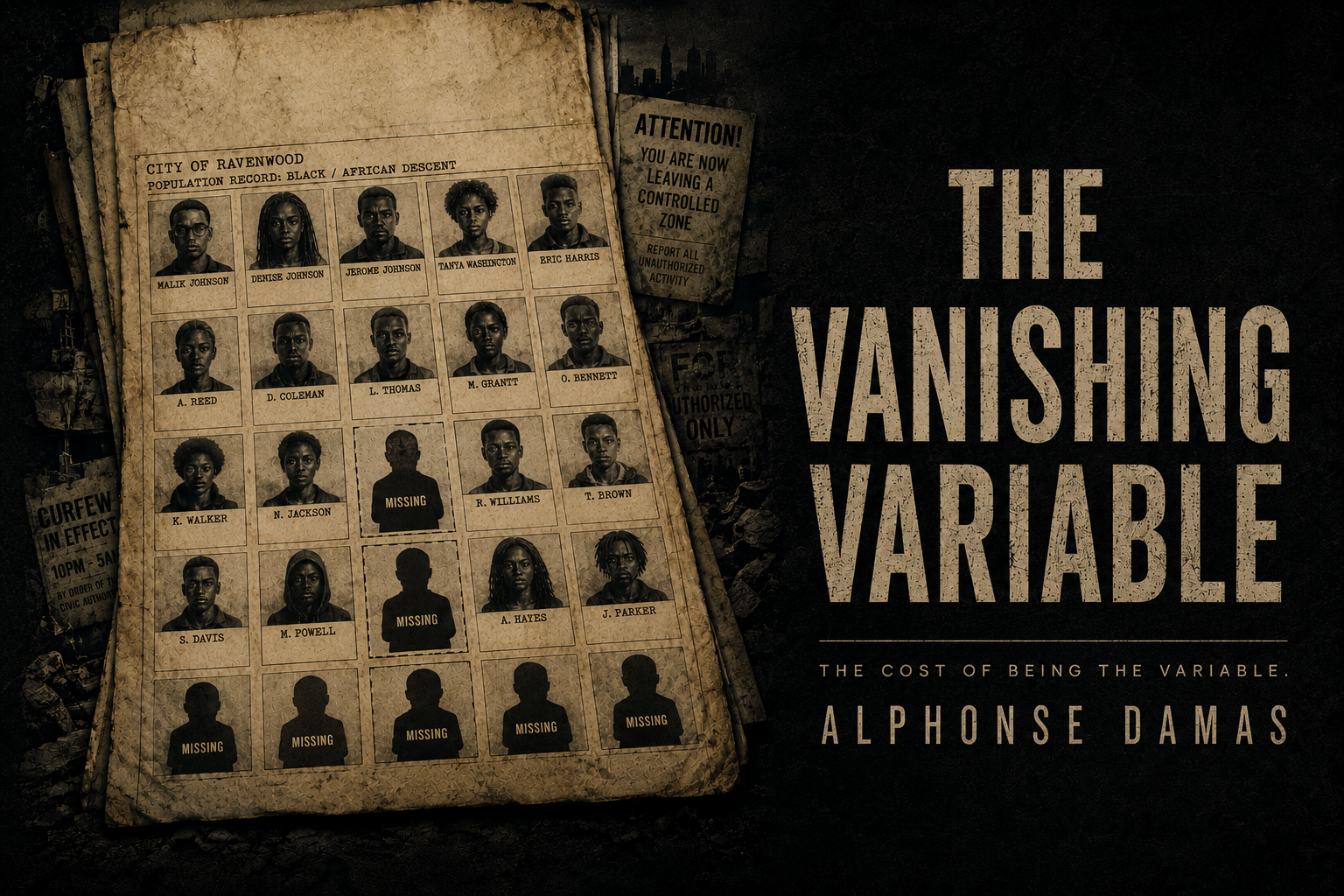
The Vanishing Variable
systems Market · Echoes From
Both worlds expose systems that depend on people they undervalue, blame, or render invisible.

⚖ Philosophical Counterpoint · ■■■■□
When Gods Stay Quiet
souls Market · Echoes From
Both interrogate the moral responsibility of those who can intervene but choose not to see dependence clearly.